
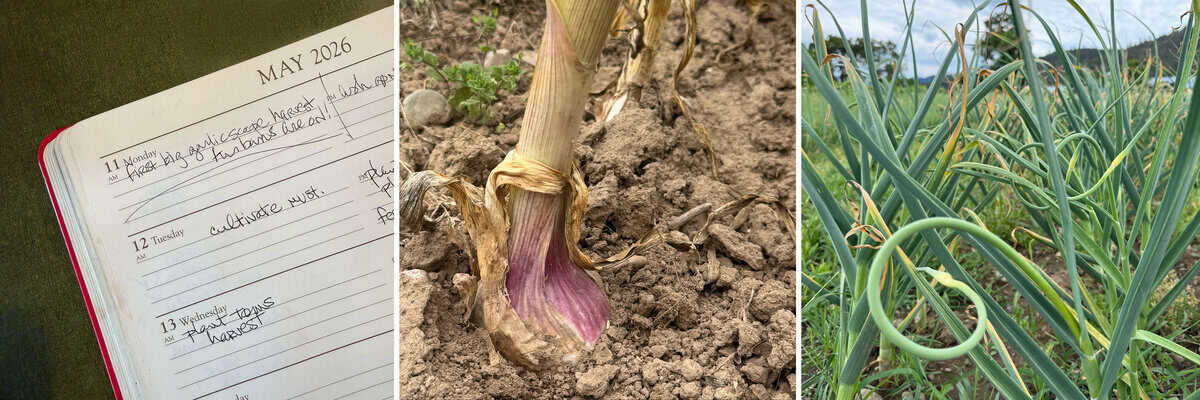
It’s hard to believe how quickly the season flies by. After the adventures of winter, the soil warms, new growth emerges, and the crazy-busy farm year is suddenly in full swing. Garlic moseys along for months, staying green and vibrant as long as weeds and gophers are held at bay and water is plentiful. Then one day the plants are bulbing, scaping, and beginning to dry down. Just when you thought you were busy enough, preparing for garlic harvest jumps to the top of the list.
Documentation: The Key to Wisdom and Future Success
Along with sorting out the logistics of how to harvest and cure your garlic crop, take the time now to pull out your phone and notebook and document everything. The more information you gather at this stage, the easier it will be to plan next season. Ideally you’ve already recorded garlic planting dates, varieties, seed size, spacing, bed-feet planted, and fertility details. Now capture the final stages of the garlic growing cycle: dates of bulbing, scaping, drying down to two green leaves, last watering, and (eventually) harvest date with conditions. Be sure to take photos of each variety in the coming weeks, with their name stakes clearly visible. Time-stamped photos are incredibly valuable for recording when varieties start bulbing, scaping, drying down, and when harvest begins. If you grow multiple varieties, this documentation helps you track the maturation sequence so you can plant next year for a smoother, staggered dry-down and harvest. Quick notes in a calendar, logbook, or voice memos while walking the field will become invaluable.
Timing the Harvest Window
Watch closely for the first signs that garlic harvest is 2–4 weeks away. Look for the lower 3–5 leaves starting to yellow and dry while the upper leaves are still mostly green. Early varieties like turbans are already sending up scapes and the artichokes are sizing up while others are just beginning to bulb. Even within the same type, some selections are consistently earlier. We walk the rows weekly, gently brushing aside soil at the base of a few plants per variety to check bulb development. We want plump, well-defined cloves that have filled out close to mature size and outer wrappers are preparing to dry down. Timing is critical. Harvest too early and you’ll get smaller bulbs with thin skins. Wait too long and the wrapper skins can split, hurting storage life. We stop watering when only two sets of green leaves remain. In our conditions, the garlic is usually ready to pull about two weeks later. (Particularly if lifting with digging forks, a bit of soil moisture makes lifting easier, so don’t let the ground get bone-dry.) With our mix of many softneck and hardneck varieties, we plan our planting sequence so we can move through the field section by section.
Logistics Planning
Here are the key details to line up in the coming weeks:
- Harvest methods: Decide how you’ll bring in the crop based on your equipment and labor. After years of digging forks, we love our undercutter followed by hand-loading onto a flatbed trailer. Plan your harvest strategy and make sure all tools are ready to go.
- Organization: Keeping varieties separate is critical. Plan dedicated crates or use barriers (row cover, tarps, etc.) during transport. Have neon flagging tape, colorful duct tape, and Sharpies ready. There’s no such thing as too much labeling!
- Weather watching: Nothing gets a crew rallying like a garlic harvest ahead of rain. But we prefer a little less excitement if possible! Check the 10–14 day forecast obsessively. You want dry plants and soil and a few days of good weather for harvest and moving the garlic under cover. Conditions can change quickly, so it pays to be staged and ready to act.
- Curing space prep: Decide where the garlic will go after harvest and make sure you have enough well-ventilated space. Think through your curing method (hanging, shocking, screening, etc.) and prepare the space and gather any needed supplies now.
* A note on curing conditions: There’s some evidence that a short spell of higher heat (110°F+) with good airflow during the early curing phase can help set back dry bulb mites / tulip bulb mites. A natural heat wave can actually be useful if you have strong ventilation.
Year after year, these records and preparations will help you choose the best varieties for your site and refine your systems. The best time to start record-keeping was years ago, but the second-best time is right now. Take notes, keep your eyes on the prize, enjoy some garlic scape pesto, and get ready for the big days ahead. The best part of the season is almost here!
Coming soon: Garlic Harvest Time is Here! Harvest and Curing for Optimal Yield, Flavor and Storage